Artistic Practice
Artistic Methodology: What Sets a Contemporary Artist Apart?
A guide to artistic methodology and concept, the difference between style and methodology, and how an artist builds a central question and a body of work.
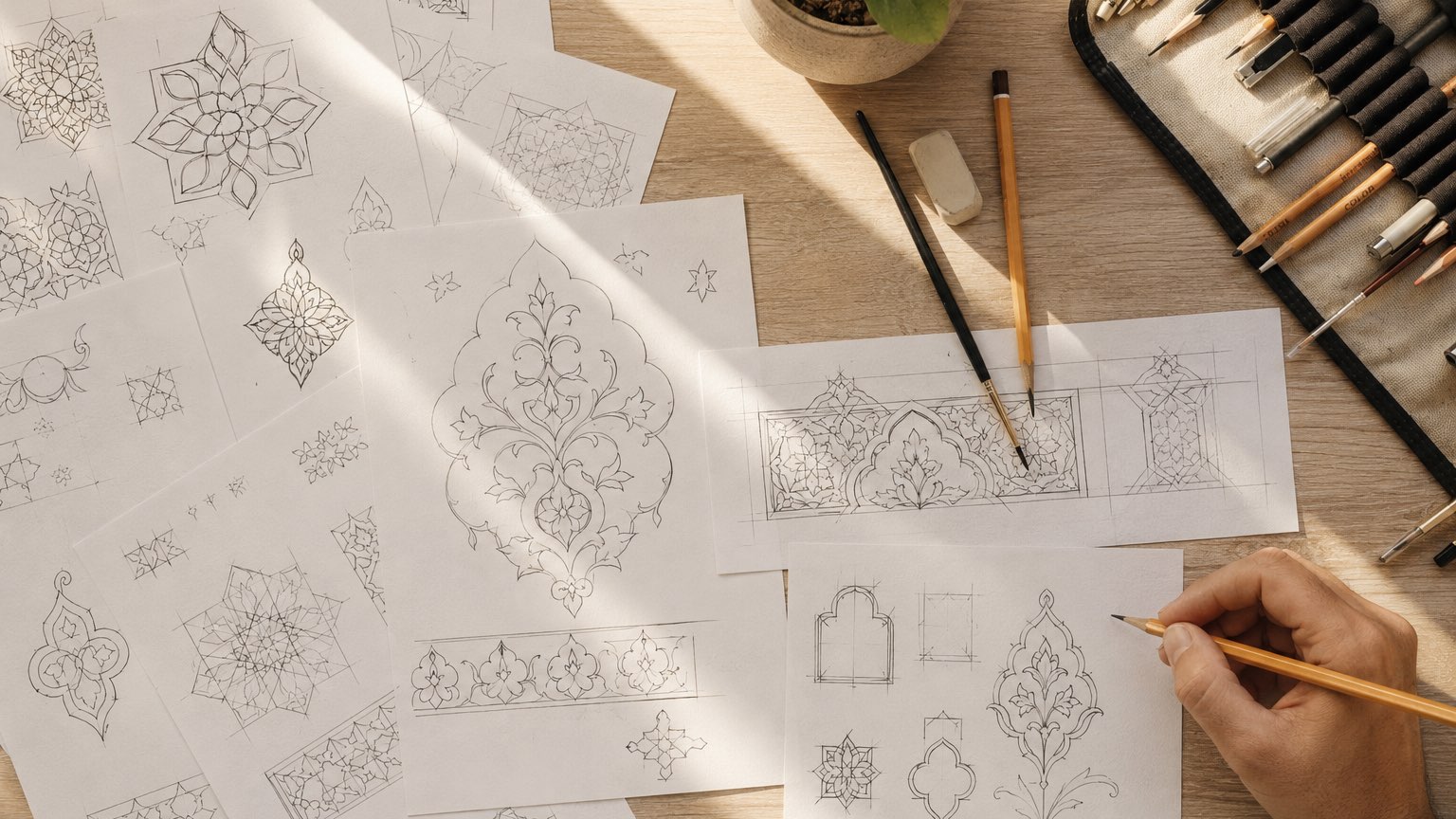
In contemporary art, what sets an artist apart is defined by the methodology of their thinking and their central concept far more than by their visual style. Your style may approach another artist's in material, technique, or final form, and yet what separates you from them remains the question you work on and the way you build the work around it. This methodology is what allows the viewer to connect with your story and your practice. It is the foundation on which contemporary art has rested since the mid-twentieth century.
This article explains what artistic methodology and concept mean, why the center of gravity shifted from style to idea, and how an artist finds a central question and turns it into a coherent body of work.
What is artistic methodology and concept?
Three overlapping terms are used interchangeably without careful distinction, and it helps to separate them:
Artistic practice is the sum of what an artist does with intention over time: the questions they pose, the sources they return to, the materials they test, and the decisions that govern each work. Practice is broader than any single work; it emerges in the accumulation of works and in the relations between them.
Methodology is the relatively stable way an artist thinks and builds their work: how they approach their subject, how they research, and how they decide that an idea is worth becoming a work. Methodology is a way of working before it is a final result.
Concept is the central idea a work engages, and the meaning it seeks to produce. Concept answers a simple question about every work: what is this work actually about, and what does it want to say?
Alongside these three sit two terms often confused with methodology: style, the recurring visual signature in form, color, and composition; and medium, the material or technique used to execute the work, such as photography, sculpture, or video. Style and medium are visible on the surface; methodology and concept lie beneath.
Why did the center of gravity shift from style to concept?
During the nineteenth century and the first half of the twentieth, the major art movements defined themselves through style and medium: Impressionism through brushstroke and light, Cubism through the fragmentation of form, abstraction through the abandonment of representation. The central question was often a question of form: how do you paint the world?
In the 1960s the question shifted, and the idea itself became the material of the work. The clearest reference for this turn is the American artist Sol LeWitt, who published Paragraphs on Conceptual Art in Artforum in 1967, followed by Sentences on Conceptual Art in 1969. LeWitt articulated the principle that defined an entire current: in conceptual art, the idea or concept is the most important aspect of the work, to the point that the idea becomes the machine that makes the work.
This shift, later described by the critic Lucy Lippard as the dematerialization of the art object, rearranged the criteria of evaluation. A work came to be read through the strength of its question and the coherence of its methodology, not through the skill of execution alone. This reading is what governs, today, how museums, exhibitions, and curatorial panels look at an artist's work: they search for a clear line of inquiry, not for scattered beautiful pieces.
Style still has value, and skill remains part of the work. But an artist with a brilliant style and no question to work on stays in the territory of craft, while an artist with a methodology and a question builds a practice that can be traced and read.
The difference between style and methodology
The quickest way to grasp the difference is to imagine two artists making works that look similar in form: one working on memory and loss, the other on architecture and the city. The surface of the two works may resemble each other, yet their meaning and trajectory remain entirely different. Style is seen; methodology is read.
| Axis | Style | Methodology |
|---|---|---|
| Definition | Recurring visual signature | Way of thinking and building the work |
| Location | On the surface of the work | Beneath the work, in its decisions and trajectory |
| Imitability | Relatively easy to imitate | Difficult to imitate, since it flows from the artist |
| Relation to medium | Often tied to a single medium | Travels across multiple media |
| What it gives | Visual distinction | Distinction and a story that can be traced |
The practical consequence: an artist may change their style or their material from one project to another without breaking their practice, as long as their central question and methodology remain constant. The coherence of a practice comes from methodology, not from the repetition of form.
How do you find your central question?
The first step in building a methodology is not technical; it is an inner search for the question worth years of work. The following questions help identify it:
- Start from a genuine preoccupation. What subject actually preoccupies you, one you feel you must express? It may be a cause, a field, a state that resembles you, or an experience you have lived. The practical test is simple: a subject you could speak about for months without stopping.
- Test its seriousness. Ask yourself: will this subject still matter to me a year from now? Can it be approached from multiple angles, or is it a single idea that ends with one work? A strong central question endures repetition and deepening.
- Work on it from every angle. Take the single subject and investigate it visually, intellectually, and historically. Try approaching it in different materials, and ask it different questions in each work. From this considered repetition a body of work emerges.
- Develop the methodology over time. A methodology is not designed in a single stroke; it clarifies through the work. Each work reveals what deserves to be pursued and what deserves to be left behind, and the method takes shape gradually.
An artist who begins from a sincere preoccupation holds an advantage that cannot be imitated: the story that binds their works to one another, and binds the viewer to them.
From idea to body of work
An idea alone does not make a practice. What turns it into a practice is a body of work: a sequence of works that revolve around a single question and develop it from one piece to the next. Here practical tools that professional artists use come into play:
- The series: consecutive works that test different facets of the same question, building depth instead of dispersion.
- The artist statement: a short text that explains the central question and methodology in clear language. Writing it forces the artist to define what they are actually working on, and later serves in applications for exhibitions, prizes, and residencies.
- Coherence across media: when the question is stable, the artist's movement between photography, sculpture, and video becomes an extension of the practice, not a break with it.
Where does the Saudi artist develop their practice today?
Since the launch of the Ministry of Culture's programs in 2020, the Kingdom has seen an institutional ecosystem that allows the emerging artist to develop their practice and reach the audience and the market:
- The Visual Arts Commission: the government entity concerned with the visual arts within the Ministry of Culture, and the commissioner of the Saudi pavilion at the Venice Biennale.
- The Diriyah Contemporary Art Biennale: the first contemporary art biennale in the Kingdom, whose first edition was held in 2021 and whose second edition, titled After Rain, was held in 2024.
- The Ithra Art Prize: a prize awarded by the King Abdulaziz Center for World Culture (Ithra) to emerging Saudi and resident artists.
- The Misk Art Institute, and the galleries and art spaces that host artistic practice and connect it with collectors.
This ecosystem means that an artist who builds a clear methodology and question finds today real pathways for presentation and support inside the Kingdom, not only outside it.
Common mistakes in building an artistic practice
- Starting from style rather than from question: mastering a visual signature without knowing what you want to say leaves the artist in the territory of craft.
- Chasing trends: imitating what spreads yields quick resemblance and zero distinction.
- Dispersion across unrelated subjects: producing scattered beautiful works makes it difficult for the curator and the collector to read the practice.
- Treating the concept as a label added after execution: a real concept drives the work from its beginning.
- Neglecting documentation: the absence of an artist statement and an archive of works weakens the artist's chances before exhibitions and prizes.
Frequently asked questions
Does artistic methodology only mean conceptual art?
No. Conceptual art is a specific historical current that emerged in the 1960s. Methodology, however, belongs to every serious artist regardless of their medium or style, because it is the way of thinking through the building of the work.
What is the difference between subject and concept?
The subject is what a work is about on the surface (the city, memory, water). The concept is the angle and the meaning the artist approaches, for example: the city as a memory being erased. The subject is shared by many; the concept belongs to the artist.
Does every work need a complex concept?
No. A strong concept is often simple and clear. Its value lies in its sincerity and its coherence with the rest of the practice, not in its complexity.
How do I begin writing an artist statement?
Begin with a single sentence that answers: what is my work about? Then add how you work on it and why it matters to you. Keep it short, clear, and free of overstatement.
In summary
The distinction of a contemporary artist is built, not born ready-made. It begins with a sincere question that preoccupies them, develops through a methodology of thinking that clarifies with every work, and matures in a body of work that can be read as a single line. Style attracts the eye; methodology makes the practice that endures. A clear idea, developed with patience, is the artist's true capital.